Wednesday, March 25, 2009

Phillip Root

Midterm

Film 301/319

3/25/09


Looking in a Mirror Made of Film


Prompt 1.

Within, “Blade Runner”, (Ridley Scott, June 25, 1982, United States), and “A Clockwork Orange” (Stanley Kubrick, February 13, 1972, United Kingdom), both challenge humanities’ perceptions of humanity by explaining the hypocrisy of the label. Gender is one such hypocrisy seen within each film by determining the view of what our society perceives the specific topic. Such instances of sexual differences are shown throughout these films, thus examining how human and non-human are constituted as human through sexual means, and by doing so, mirroring our world’s perspective of what humanity is in those means.

            In, Blade Runner, gender is touched upon by the use of Androids known as Replicants, who serve human beings in conquering off-world colonies. Both women Replicants who escaped his duty were used in combat, yet what is brought up in the film is how the female replicants are used to men’s needs specifically. The character of Pris is constituted as being a sexual object for the crew of the off world expeditions, and this creates a reflection of how society views women as objects, rather than competent human beings with opinions and thoughts. How this is supported is through the other female replicant Zhora, whose specialty consisted of combat, yet as soon as she returns to earth in hiding, her only occupation is being an erotic dancer. Logic puts together that even though she has no information or identify in human terms, her gender is enough to still be perceived as a sexual object.


            Society’s viewpoint of how women are objects are also realized in, A Clockwork Orange, which also follows this characterization of gender. Multiple instances in the film display how women are objects, starting in the beginning sequence of the Milk Bar.  Alex and his clan of criminal Droogs, sit in a bar served with drug-induced milk, and are surrounded by statues of women exposed and used as furniture.   Alex is known as the non-human entity of the film by his sheer madness and sexual exploits, which correlate with his surrounding, consisting of degrading women in the bar. 

a-clockwork-orange-alex-at-the-korova-milk-bar1.jpg


Mirroring our desires, Alex shows the extreme nature of male superiority supported by what he calls, “ultra- violence”. In these acts, Alex takes advantage of women through rape without consent, and taking away the rights of the female. An example occurs when Alex and his Droogs invade the home of the Alexander’s and brutally rape Mrs. Alexander in front of Frank Alexander.  Taking away all rights and power of the women, we witness the revolting representation of how women rights are taken advantage due to their physical aspects.

            Historical context gives significance to these ideals of gender, by looking at the past of the social perception of women’s roles in society. Being that the fifties and sixties established the women’s roles as housekeepers and sheppards of children, a false and narrow perception of what a women was able to achieve was made. Superiority of the male was seen as being commanding to the household as the provider to the family, and through this image, gave an unfair inferiority of women. Both films showed how women are still degraded and through the reflection of the replicants and women of fantasy by Alex.

            This concept of societies perception of women is thus challenged by each of these films’ character’s by also giving power to women in different regards. For, Blade Runner, Pris plays innocence of a child, establishing her femininity, but that does not encompass her. She is intriguing and smart, which reflects the rising feminist moment in the seventies, which preceded the making of the film in 1982. Her power of understanding the situations of escape and survival without a male counterpart shows the individual strength of independent women. Though she has her relationship with a male replicant named Roy Batty, she does not depend on him, but rather helps Roy Batty achieve his goals of reaching his maker, Tyrell, through her intelligence.

When Alex decides to continue his violent tirade against a health farm director, he finds the challenge to gender role by the embodiment of the, “cat lady”, who runs the farm. Instead of being taken advantage, she confronts Alex’s desires and shows dominance, which correlates with the empowerment of a woman. This action brings justice to Alex by putting him into prison and gives punishment to his ludicrous actions. This display of power gave a voice for the female majority by visually exhibiting the strength of a woman in times of gender repression and degradation.


            Each picture paints a different shade of what women have been characterized as, and with each film commenting on gender, the divide becomes evident. The harsh reality of gender classification is shown in horrible lights, yet is shown through main characters that have either have no soul, or a tortured one. These examples give the public an understanding of our bias towards gender and let us reflect upon the injustices we face everyday, and with this information give a route to take to pursue a brighter future.


Prompt 2.


In, Blade Runner, and A Clockwork Orange, ethnicity and racial difference are touched upon and delve deeper into humanity. From Roy Batty’s Aryan supremacy to that of the British government’s attempts to reform Alex, the films look beneath the outer shell to discover startling truths. The concept of what life should be and how to accomplish the goal of normality gives the viewer an understanding of our structures that have been built in our society and the motives used to maintain the status quo, even when they in fact destroy what humanity is.

            The character of Alex in, A Clockwork Orange, is young man obsessed with violence, sex, and Beethoven, and for these excessive traits is looked as inhuman. Ethnicity plays a major part in the film, by trying to reform Alex to fit into society yet raping him of his human identity. This is done by a process called the, Ludovico Technique, which exposes the patient to violent images, supplied with a serum to invoke feelings of displeasure. Alex’s nature is changed, but by the standards of keeping the ethnicity of a near future Britain composed.  Even though it was successful, the technique took away the essential piece of life, that being choice in his actions and morality.

a_clockwork_orange_movie_image.jpg

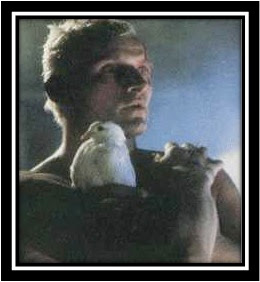
         Race becomes an issue as well in the film, “Blade Runner”, by examining the Aryan philosophy of perfection. Roy Batty symbolizes this example by being physically demanding and excelled beyond his counterparts, yet is ingrained with the imperfections of humanity. Imperfections that are the expiration of his life in three years, thus correlating with his quest for an extension of life, and by pursuing this goal shows the high expectations of a higher being. This superiority complex fits the Aryan label, by determining that the actions of Roy Batty are beyond the label of a replicant.  Furthermore through the creation of Batty, the underlying message of humanity grasping for Godlike qualities in reproduction are exposed. As Judith Kerman put it in, “Retrofitting Blade Runner”.

            “If human culture creates artificial life, does such life deserve to be embedded in the same ethical discourse which we apply to naturally-evolved life, and especially human life?” (4)

This quote brings up ethnicity and race which correspond with the nature in which each of the characters in the films represent a non-human entity created by their societies. With Alex, the world is unstructured and violent, and thus creates the entity he is. From his reformation society discovers that though his desires are evil by their morality, they are essential to humanity. As I.Q. Hunter put it in, “British Science Fiction Cinema”, “…science and humanity are incompatible.” (3)

With Roy Batty, his fate given to him by his maker, Tyrell, is found to fit society’s mold of life and death. Reason being that life is short and to understand the beauty it contains, one must come to terms with its brevity.  Human and non-human resolution in these films give the viewer a greater appreciation of what life entails, by bringing up topics such as sex, life, morals, and anger. These subjects let the public look towards what in our society needs to change; yet also allows for the public to understand our humanity, and through this examination brings enlightenment.

3414251_Roy_Dies.jpg


Works Cited

1. Blade Runner. Dir. Ridley Scott. Perf. Harrison Ford. Warner Brothers, 1982.

2. A Clockwork Orange. Dir. Stanley Kubrick. Perf. Malcolm Mcdowell. Warner Brothers, 1971.

3. Hunter, I.Q. British science fiction cinema. Routledge, 1999.

4. Kerman, Judith B. Retrofitting Blade Runner Issues in Ridley Scott's Blade Runner and Phillip K. Dick's Do Androids Dream of Electric Sheep? New York: Popular P 3, 1997.

Wednesday, February 18, 2009

Artificial Freedom and Intelligence


Phillip Root
Film 301/319
February 18, 2009
Visual Assignment 1

Artificial Intelligence and Freedom

When looking towards the future, one must ask the questions of what shall be, or what could be, and with Blade Runner (Ridley Scott, 1982, Los Angeles and Burbank, California. Sheppertion, and Surrey, England, UK.), the audience is shown a unique perception of a possible future. With the financing of 15 million from Warner Brothers studios (1), Ridley Scott was able to create an incendiary world of fantasy, while maintaining a logistical take on what the future could be. With the basis of the book, “Do Androids dream electric sheep” (2), by Phillip K. Dick, Scott began to craft a tale of the future loosely based upon the text. From the emphasis on freedom, and cultural lines blurring, the question the movie poses is what made a human, human? These answers and more were examined throughout this science fiction epic from Ridley Scott in the proposed future in 2019.


Coming off of the enormous success of Aliens, and the mourning over the death of his brother, Ridley Scott began the journey towards creating a film that once again would visually and mentally arrest the viewer (5). Considering the films being made at the time such as, Close Encounters of the Third Kind, by Steven Spielberg (9), and “The Empire Strikes Back”, by George Lucas (11), Scott was given the freedom to create a film with both an exciting visual concept and the capacity for philosophical undertones. Such evidence is in the way in which Scott establishes humanity within his science fiction films. This humanity was present through his ability to create humanity in his earlier science fiction film Alien, by creating a blue-collar mentality to the characters, or as he called it, “truckers in space”(5). This mentality created an opportunity to service the story in a new and fresh strategy, by allowing the audience to connect to the journey taken by Harrison Ford’s character, Rick Deckard.

Following the main character of Rick Deckard, the audience is shown the city of Los Angeles in 2019. The world of factories and clashing cultures, crashed together by overpopulation and globalization, created an incredible sense of mise en scene for the picture to convey the image of claustrophobia. With the narrative following the use of a science fiction setting through the use of flying vehicles and larger than imagined architecture, the audience is thus transported. The story focuses on Deckard, a former Blade Runner, which is the label for an assassin of Androids known as Replicants. The main functions of these machines are to work as the slaves for the off-world planets, even though they resemble humans in learning and features. Upon the escape of six replacints, Deckard is once again asked to terminate the problems that exist. The main replicant is a challenge, because with his ability to learn and reason, the story takes an unexpected turn.


Rob Batty, the head replicant responsible for the exodus, escapes slavery to come to earth to plea for extra life from his creator J.F. Sebastian. This topic of a robot wanting life or even fathoming the concept of life is remarkable due to the time in which the film was made. Considering the original character concept of androids such as Robby in, Forbidden Planet (10), and C-3P0 in, The Empire Strikes Back (11), androids had a structured purpose that dealt with servitude and the role of support to human kind. This perspective on free will and determination for freedom was new territory, and with the murder of Tyrell, his original creator by the hands of Batty due to his refusal for extended life, the film thus takes on a different viewpoint of what purpose an android has.


The historical context of the film also correlates with the effect of slavery and inferiority. According to Judith Kerman, in her book, “Retrofitting Blade Runner”, “That the replicants are perceived by the police as inferior is made clear by the racial epithet with which they are characterized by Capt. Bryant.”(3) This name used is “skin jobs”(3) and with this term is associated a prejudice connecting with any other racist term degrading person. Feeling oppressed, Batty revolts and thus embodies the spirit of change and civil rights justice. Conjuring characteristics of both Martin Luther King Jr. and Malcolm X, Batty is similar in achieving freedom through action and peace. For example, when Batty interrogates one of the Engineers for information to find J.F. Sebastian, a man with the key to his continuing existence. Batty's methods of assertiveness reflect a urgency reserved for the actions of a human. This reflects the methods of action in which Malcolm X, as he would quote, “by any means necessary”(6). Yet Batty also relates to Martin Luther King Jr., by showing mercy and remorse for Deckard in the final conflict on the top of the skyscrapers. This compares to the actions taken by King, by showing mercy and remorse for the white moderate were naive and arrogant, as clearly stated in King’s writings from Birmingham jail (4). Considering as well the context in which Scott portrays this touchy issue was in fact a current issue of what Phillip K. Dick was experiencing while writing the source text. During the sixties, the Civil Rights Movement was in affect, and with the Civil Rights Acts of 1964, 1965, and 1968(4) a new and unknown era was beginning, which is envisioned through the film with the merging of one society.

Through the progress made in racial divisions, questions in the film arose of how far we could go in blending together. Such an example is seen through the character of Gaff, a Hispanic officer, who uses a combined language assorted by the multiple cultures mixed together, which is called, “Cityspeak”(1). With this new culture, new ideas are mixed within each other to form something new and spell bounding. From the incredible frame of the Geisha visual advertisement reflected across the incredibly enormous skyscraper, we visually see an underlying message of the crossover of cultures. Meaning that advertising that was made for Asians primarily, now was nationally known in the future of 2019, from the shrinking world that has evolved into globalization.


These questions posed by the original text by Dick and modernized by Scott, gave the viewer questions to ponder considering where our world was headed, and where it had been. The possibility of technology becoming aware or in fact, evolving towards a state of consciousness is paranoia for us as a society due to our inability to grasp change, as seen by our segregated past. Yet also shows how change can be hazardous due to the possible ability to play god by creation, or create new prejudices. What makes the film work is the idea of the unexpected or the acceptance that the world is unknown. That the science fiction genre can be pulled down to examine an intimate story of learning the concept of love instead of hate and resentment. Shown in Deckard’s character, we see a loss in connection at the beginning of the film, with his flying car and aspirations of his own freedom from his occupation, or slavery in a sense. When looking at the concluding sequence of the film we see his love for an Android by the name of Rachael, juxtaposed from his earlier surroundings, he is seen as free in a car riding through a beautiful countryside (8). This idea of freedom through the power of open-minded idealism creates a masterpiece of contemporary film by the true modern genius of Ridley Scott.


Works Cited


1. "Blade runner - Wikipedia, the free encyclopedia." Wikipedia. 14 Feb. 2009 .

2. Dick, Philip K.. Do Androids Dream of Electric Sheep?. Pg. 112 New York: Signet, 1969.


3. Kerman, Judith B.. Retrofitting Blade Runner: Issues in Ridley Scott's Blade Runner and Phillip K. Dick's Do Androids Dream of Electric Sheep?. Bowling Green State University: Popular Press 3, 1997.

4. King, Jr., and Martin Luther. Letter from the Birmingham Jail. New York: HarperCollins, 1963.

5. "Ridley Scott - Wikipedia, the free encyclopedia." Wikipedia, the free encyclopedia. 15 Feb. 2009 .

6. Speeches, Any Means Necessary:, and Interviews. "Malcolm X - Wikipedia, the free encyclopedia." Wikipedia. 15 Feb. 2009 .

7. Alien (Two-Disc Collector's Edition). Dir. Ridley Scott. Perf. Sigourney Weaver. DVD. 20th Century Fox, 1979.

8. Blade Runner (Four-Disc Collector's Edition). Dir. Ridley Scott. Perf. Harrison Ford. DVD. Warner Home Video, 1982.

9. Close Encounters of the Third Kind (30th Anniversary Ultimate Edition). Dir. Steven Spielberg. Perf. Richard Dreyfuss, François Truffaut, Teri Garr. Theater viewing. Sony Pictures, 1977.

10. Forbidden Planet. Dir. Fred M. Wilcox. Perf. Leslie Nielsen. DVD. Warner Home Video, 1956.

11. Star Wars, Episode V- The Empire Strikes Back (Widescreen Edition). Dir. Irvin Kershner. Perf. Harrison Ford. Theater viewing. 20th Century Fox, 1982.

Artificial Freedom and Intelligence